
Hygrothermal transfers have a decisive influence on the thermo-hydraulic behavior and durability of building materials. They directly influence energy performance of buildings, thermal comfort of occupants, and longevity of structures. This study presents a comparative analysis of heat and mass transfer mechanisms in various commonly used building materials, such as concrete, cement blocks, compressed earth bricks (CEB), and cut laterite blocks (CLB). The analysis is based on the thermo-hydraulic properties of these materials, as well as on the coupled phenomena of thermal conduction and water vapor diffusion. The materials are assumed to be placed in air. We used a numerical method to solve the equations. This numerical method involved formulating the transport equations according to the Luikov model. These equations are solved using an implicit finite-difference scheme. A Fortran code combined with the Thomas algorithm for solving the equations was developed and validated using the literature. The results are presented as the spatiotemporal evolution of temperature and moisture content at the center of the materials. The results show that hygrothermal transfers depend on the temperature of the air in contact with the materials. When this air temperature increases, the temperature within the materials increases by 5%. However, this increase is more rapid in cementitious materials, where it can reach 10%. The moisture content decreases by 0.3% for most materials, except for cementitious materials, which decrease by 0.5%. Materials with low thermal conductivity conduct less heat and retain more moisture.
| Published in | American Journal of Modern Physics (Volume 15, Issue 3) |
| DOI | 10.11648/j.ajmp.20261503.14 |
| Page(s) | 96-103 |
| Creative Commons |
This is an Open Access article, distributed under the terms of the Creative Commons Attribution 4.0 International License (http://creativecommons.org/licenses/by/4.0/), which permits unrestricted use, distribution and reproduction in any medium or format, provided the original work is properly cited. |
| Copyright |
Copyright © The Author(s), 2026. Published by Science Publishing Group |
Heat Transfer, Mass Transfer, Building Materials, Thermo-hydraulic Behavior, Energy Performance
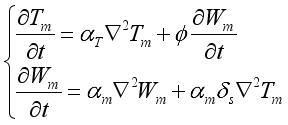 (1)
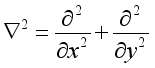
(1) 

 : mass diffusion coefficient of water in the material
  : thermal diffusivity coefficient of heat in the material
  : latent heat of vaporization
  : Phase change rate
  : specific heat
  (Initial temperature of the material)
  (Initial moisture content of the material)
 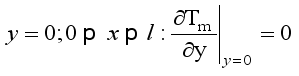 (2)
(2) 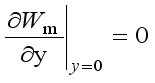 (3)
(3) 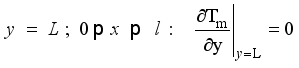 (4)
(4) 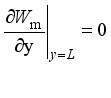 (5)
(5)  (6)
(6)  (7)
(7)  =
= 
 : thermal conductivity of the material,
  : thermal conductivity of the fluid (air),
  : density of the fluid (air),
  : water vapor concentration or dry-basis water vapor content at the materials surface,
  : water vapor concentration or dry-basis water vapor content of the air,
  : convective heat transfer coefficient,
  : convective mass transfer coefficient,
  : water vapor mass diffusion coefficient (m²·s⁻¹).
  (8)
(8) 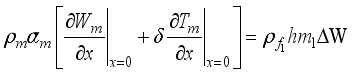 (9)
(9)  (10)
(10) 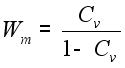 (11)
(11) 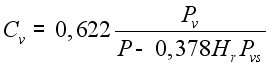 (12)
(12)  (13)
(13) 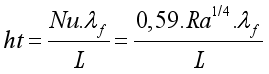 (14)
(14) 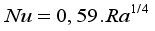 (15)
(15) 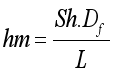 (16)
(16)  (17)
(17) Materiel | (W/m·K) | (kg/m³) | (J/kg·K) | (m²/s) |
|---|---|---|---|---|
Concrete block | 1.32(±0.22) | 2150(±0.18) | 1818(±0.05) | 3.37 × 10⁻⁷(±0.03) |
Concrete | 2.11 (±0.33) | 2350 (±0.02) | 1800 (±0.18) | 4.98 × 10⁻⁷ (±0.11) |
CEB | 0.72 (±0.21) | 1800 (±0.24) | 1900 (±0.28) | 2.10 × 10⁻⁷ (±0.06) |
CLB | 0.91 (±0.29) | 2100 (±0.01) | 1700 (±0.30) | 2.54 × 10⁻⁷ (±0.16) |
CEB | Compressed Earth Bricks |
CLB | Cut Laterite Blocks |
| [1] | D. Sawadogo and Ousmane Coulibaly, «Comparative Study of the Thermal Comfort of Four Materials Type Used in the Construction of a Building,» Journal of Energy and Power Engineering, vol. 15, pp. 231-242., 2021. |
| [2] | Nadezhda S. Bondareva, Mikhail A. Sheremet, «Heat transfer performance in a concrete block containing a phase change material for thermal comfort in buildings»Energy&Buildings. 2021. journal. |
| [3] | John Smith, Maria Johnson, Ahmed Khan,«Laboratory versus field conditions for cement-based materials: A comparative study» Journal of construction and BuldingMaterials, vol. III, n°152. p. 152-165, 2021. |
| [4] | P. Crausse, G. Bacon et S. Bories, «Etude fondamentale des transferts couplés chaleur-masse en milieu poreux,» International journal heat and mass transfer. vol. 24, n° 16, p. 991-1004, 1981. |
| [5] | J. R. Philip, D. A. Devries,«Moisture mouvement in porous materials under temperature gradients,» Transaction American Geophysical Union, vol. 38, n°12, 1957. |
| [6] | A. V. Luikov., «Systems of differential equations of heat and mass transfer in capillary-porous bodies» International journal of heat and mass transfer, vol. 18, pp. 1-14, 1975. |
| [7] | Abahri. K, Belarbi. A, Trabelsi. A, «Contribution to analytical and numerical study of combined heat and moisture transfers in porous building materials,» Building and environment, vol. 46, p. 1354-1360, 2011. |
| [8] | M. Qina, A. Mokhtarc, R. Belarbic «Two-dimensional hygrothermal transfer in porous building materials» Applied ThermalEngineering/ vol. 30, p. 2555–2562, 2010. |
| [9] | Sotehi. N, Chaker. A, «Numerical analysis of simultaneous heat and mass transfer in crok lightweight concretes used in building envelopes.» Eigth International conference on material sciences, vol. 55, pp. 429-436, 2014. |
| [10] | Benjamin Kiema, Ousmane Coulibaly, Xavier Chesneau, Belkacem Zeghmati, «Numerical Modelling of Coupled Heat and Mass Transfer in Porous Materials: Application to Cinder Block Bricks.,» Open Journal of Applied Sciences, vol. 14, p. 2360-2373, 2024. |
| [11] | A. Choplin, A. BASTIN, «Matière grise de l’urbain. La vie du ciment en Afrique» Open Edition Journal, vol. II, n°129. p. 252 -255, 2020. |
| [12] | S. M. Henderson, «A basic concept of equilibrium moisture» Agri. Eng, vol. 33, p. 29–32, 1952. |
| [13] | Benjamin Kiema, Ousmane Coulibaly, Emmanuel Ouedraogo «Study of The Influence of Storage Media on the Thermo-mechanical Behavior of Concrete and Cement Blocks,» Physical Science International Journal, vol. 28, n°11, pp. 45-55, 2024; Articleno. PSIJ. 112918. |
| [14] | Meriem Saidi, Amel Soukaina Cherif, Ezeddine Sediki, Belkacem Zeghmati, «Analyse Numérique du Comportement Thermo-hydrique de Briques de Terre Stabilisée au Ciment,» chez 5 ème Conférence Internationale des Energies Renouvelables (CIER-2017).[Numerical Analysis of the Thermo-Hydraulic Behavior of Cement-Stabilized Earth Bricks,”presented at the 5th International Conference on Renewable Energy (ICRE-2017)] Proceeding of Engineering and Technology-PET. Vol. 31 PP. 1-6, 2017. |
| [15] | B. Kiema, W. Zoungrana, I. Konkobo, A. Koanda, O. Coulibaly, A. Bere,«Influence of Temperature on the Sorption Isotherms of Building Materials» Physical Science InternationalJournal, vol. 29, n° 1 PSIJ. 140757, p. 143-152, 2025. |
| [16] | B. Kiema, D. Sawadogo, H. Sankara, O. Coulibaly, X. Chesneau, B. Zeghmati, «Experimental study and modelling of sorption isotherms of cement blocks» International Journal of Current Research, vol. 17, n°103. p. 32001-32005, 2025. |
| [17] | GUO Lixia, GUO Lei, ZHONG Ling, ZHU Yueming, «Thermal Conductivity and Heat Transfer Coefficient of Concrete» Journal of Wuhan University of Technology-Mater. Sci. Ed. Aug. 2011 vol. 26, n°104, pp. 791-796, 2023. |
| [18] | Kodur. V, R. Sultan, M. A «Effectof Temperature on the Thermal Properties of Fiber-Reinforced Concrete,» Journal of Materials inCivilEngineering/ vol. 5, n°12, pp. 101-107, 2024. |
| [19] | Daouda Sawadogo, Benjamin Kiéma, Ousmane Coulibaly, «Optimization of a Building's Indoor Temperature and Sensitive Air Conditioning Loads Using the BLT Parpaing Hollow Double Wall» Physical Science International Journal, vol.Vol. 30, n° 1 Articleno. PSIJ. 152915. pp. Page 14-25, 2026. |
| [20] | Ramezannia, A., Gocer, O. and Tabrizi, T. B. «The Life Cycle Assessment of Stabilized Rammed Earth Reinforced with Natural Fibers in the Context of Australia» Construction and Building Materials, 2024. 416, Article 13503. |
APA Style
Kiema, B., Cisse, S., Kabore, H., Coulibaly, O. (2026). Comparative Study on Hygrothermal Behavior of Sustainable Building Materials. American Journal of Modern Physics, 15(3), 96-103. https://doi.org/10.11648/j.ajmp.20261503.14
ACS Style
Kiema, B.; Cisse, S.; Kabore, H.; Coulibaly, O. Comparative Study on Hygrothermal Behavior of Sustainable Building Materials. Am. J. Mod. Phys. 2026, 15(3), 96-103. doi: 10.11648/j.ajmp.20261503.14
@article{10.11648/j.ajmp.20261503.14,
  author = {Benjamin Kiema and Salifou Cisse and Hermann Kabore and Ousmane Coulibaly},
  title = {Comparative Study on Hygrothermal Behavior of Sustainable Building Materials},
  journal = {American Journal of Modern Physics},
  volume = {15},
  number = {3},
  pages = {96-103},
  doi = {10.11648/j.ajmp.20261503.14},
  url = {https://doi.org/10.11648/j.ajmp.20261503.14},
  eprint = {https://article.sciencepublishinggroup.com/pdf/10.11648.j.ajmp.20261503.14},
  abstract = {Hygrothermal transfers have a decisive influence on the thermo-hydraulic behavior and durability of building materials. They directly influence energy performance of buildings, thermal comfort of occupants, and longevity of structures. This study presents a comparative analysis of heat and mass transfer mechanisms in various commonly used building materials, such as concrete, cement blocks, compressed earth bricks (CEB), and cut laterite blocks (CLB). The analysis is based on the thermo-hydraulic properties of these materials, as well as on the coupled phenomena of thermal conduction and water vapor diffusion. The materials are assumed to be placed in air. We used a numerical method to solve the equations. This numerical method involved formulating the transport equations according to the Luikov model. These equations are solved using an implicit finite-difference scheme. A Fortran code combined with the Thomas algorithm for solving the equations was developed and validated using the literature. The results are presented as the spatiotemporal evolution of temperature and moisture content at the center of the materials. The results show that hygrothermal transfers depend on the temperature of the air in contact with the materials. When this air temperature increases, the temperature within the materials increases by 5%. However, this increase is more rapid in cementitious materials, where it can reach 10%. The moisture content decreases by 0.3% for most materials, except for cementitious materials, which decrease by 0.5%. Materials with low thermal conductivity conduct less heat and retain more moisture.},
 year = {2026}
}
TY  - JOUR
T1  - Comparative Study on Hygrothermal Behavior of Sustainable Building Materials
AU  - Benjamin Kiema
AU  - Salifou Cisse
AU  - Hermann Kabore
AU  - Ousmane Coulibaly
Y1  - 2026/05/29
PY  - 2026
N1  - https://doi.org/10.11648/j.ajmp.20261503.14
DO  - 10.11648/j.ajmp.20261503.14
T2  - American Journal of Modern Physics
JF  - American Journal of Modern Physics
JO  - American Journal of Modern Physics
SP  - 96
EP  - 103
PB  - Science Publishing Group
SN  - 2326-8891
UR  - https://doi.org/10.11648/j.ajmp.20261503.14
AB  - Hygrothermal transfers have a decisive influence on the thermo-hydraulic behavior and durability of building materials. They directly influence energy performance of buildings, thermal comfort of occupants, and longevity of structures. This study presents a comparative analysis of heat and mass transfer mechanisms in various commonly used building materials, such as concrete, cement blocks, compressed earth bricks (CEB), and cut laterite blocks (CLB). The analysis is based on the thermo-hydraulic properties of these materials, as well as on the coupled phenomena of thermal conduction and water vapor diffusion. The materials are assumed to be placed in air. We used a numerical method to solve the equations. This numerical method involved formulating the transport equations according to the Luikov model. These equations are solved using an implicit finite-difference scheme. A Fortran code combined with the Thomas algorithm for solving the equations was developed and validated using the literature. The results are presented as the spatiotemporal evolution of temperature and moisture content at the center of the materials. The results show that hygrothermal transfers depend on the temperature of the air in contact with the materials. When this air temperature increases, the temperature within the materials increases by 5%. However, this increase is more rapid in cementitious materials, where it can reach 10%. The moisture content decreases by 0.3% for most materials, except for cementitious materials, which decrease by 0.5%. Materials with low thermal conductivity conduct less heat and retain more moisture.
VL  - 15
IS  - 3
ER  -
Department of Physics, Joseph KI-ZERBO University, Ouagadougou, Burkina Faso
Department of Physics, Joseph KI-ZERBO University, Ouagadougou, Burkina Faso
Department of Physics, Joseph KI-ZERBO University, Ouagadougou, Burkina Faso
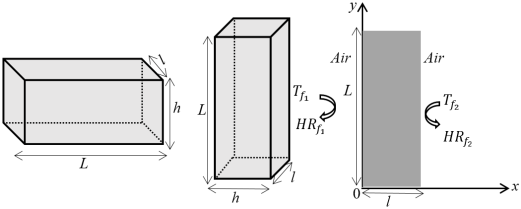
Figure 1. Physical representation.
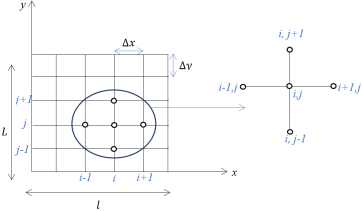
Figure 2. Mesh of the study area.
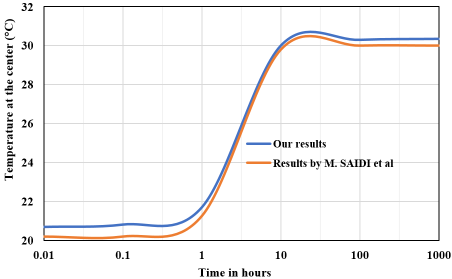
Figure 3. Temperature at the center of the material.
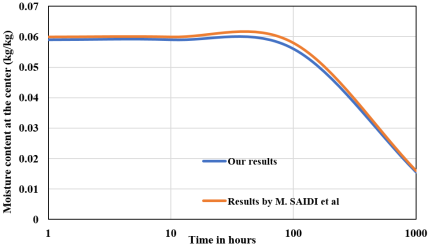
Figure 4. Moisture content at the center of the material.
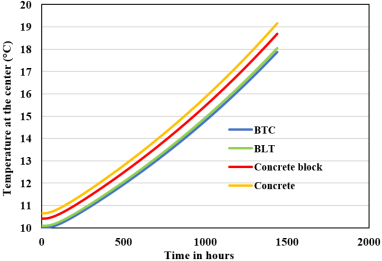
Figure 5. Temperature evolution at the center according to material type.
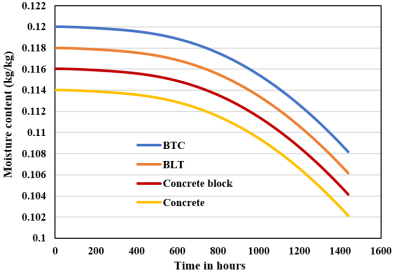
Figure 6. Moisture content at the center according to material type.

Information



 Share This Article
 Twitter
 Linked In
 Facebook
 Copy
Copy Download